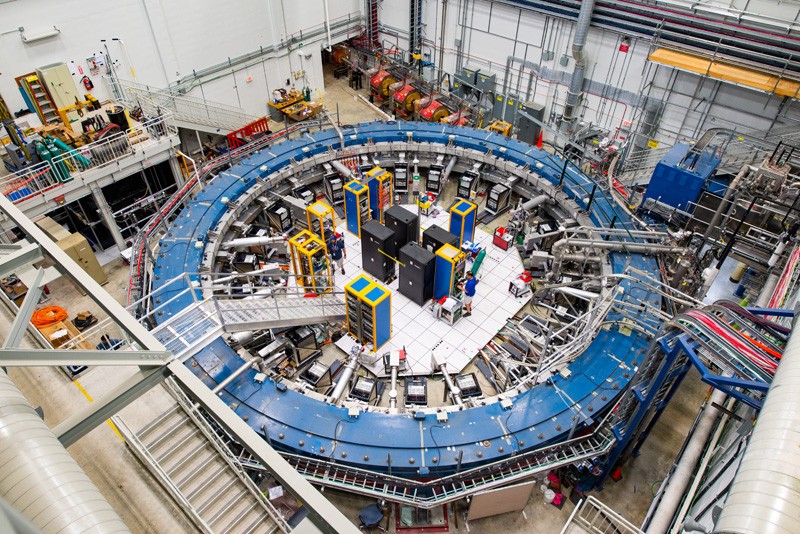
World-best measurements made in mission to crack muon mystery
911±ŹÁÏscientists have played a key role in achieving the world’s most precise measurement of a mysterious property of the muon, a subatomic particle that could help reveal new physics beyond our current understanding.
The breakthrough, , the U.S. Department of Energy’s Fermi National Accelerator Laboratory, brings researchers one step closer to discovering forces or particles beyond the Standard Model of physics.
This result represents the most precise measurement ever made at a particle accelerator anywhere in the world, and could help unlock the secrets of the universe.
What is the Muon g-2 Experiment?
The Muon g-2 experiment investigates the subtle “wobble†in the motion of muons, particles similar to electrons but with 200 times more mass, as they move through a magnetic field.
This wobble, known as the muon’s ‘anomalous magnetic moment’, or g-2, provides one of the most sensitive and precise tests of the Standard Model of particle physics, the theory that explains how fundamental particles and forces interact.
Landmark results
This announcement reveals the experiment’s third and final measurement, which confirms earlier results, but with a much better precision of 127 parts-per-billion, surpassing the original experimental design goal of 140 parts-per-billion.
These results now stand as the world’s most accurate measurement of the muon magnetic anomaly.
Representing more than a decade of work, this milestone is expected to stand as the definitive benchmark for testing the Standard Model for years to come.
Critical UK contribution
Scientists from the Universities of Manchester, Lancaster, Liverpool, and University College London were central to the experiment, which brought together 176 researchers from 34 institutions across seven countries.
The UK-built straw tracking detectors were essential in tracing the motion of the muon beam, a critical part of the analysis that enabled this unprecedented level of precision.
The University of 911±ŹÁÏwas responsible for mapping the vertical oscillations in the beam motion using the detectors and in the theory prediction for the measured value.
Professor Mark Lancaster, Principle Investigator of the UK groups from The University of Manchester, said: “This is the most precise measurement ever made at a particle accelerator and the culmination of over a decade’s work. The motion of the muon beam was exquisitely traced by the UK-built straw tracking detectors and was a key part of the analysis. That we now have a measurement to a precision of 0.1 parts per million and a theoretical prediction, to 0.5 parts per million, is a remarkable achievement from the work of hundreds of people.â€
STFC’s Professor Sinead Farrington, Director of Particle Physics, added: “What’s really fascinating about this result is the way it has illustrated the interplay between theoretical predictions and experimental results - each can lead the other, and make demands on the precision of the other.
“The UK has played critical roles of which we can be proud, both in leadership and in developing the straw tracking detectors, in this highly international collaboration.â€
Read the at the Fermilab website.
The University of 911±ŹÁÏis globally renowned for its pioneering research, outstanding teaching and learning, and commitment to social responsibility. We are a truly international university – ranking in the top 50 in a range of global rankings – with a diverse community of more than 44,000 students, 12,000 staff and 550,000 alumni from 190 countries. Sign up for our e-news to hear first-hand about our international partnerships and activities across the globe.